
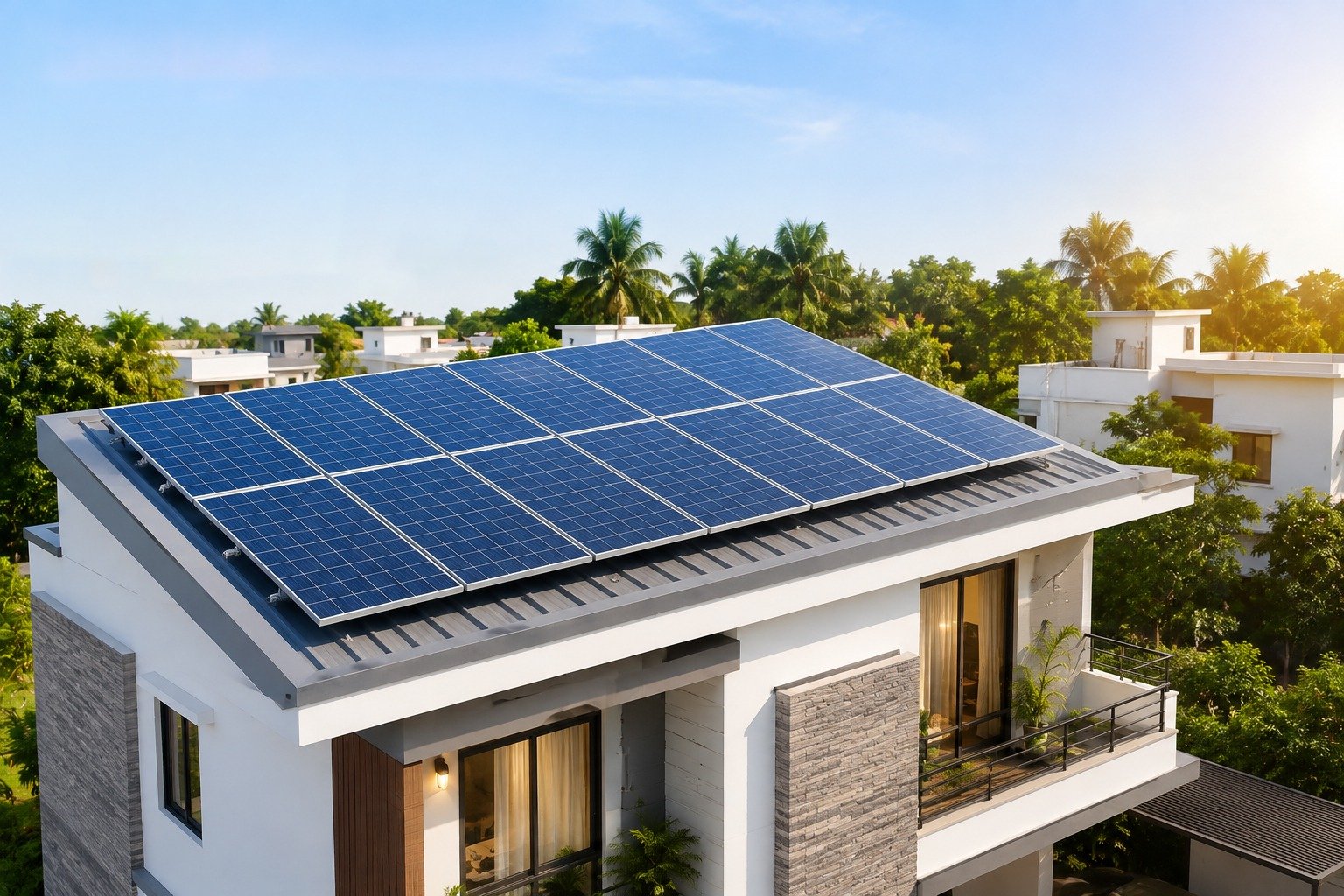
Residential rooftop solar
A home system should be sized to how your family actually uses power — not to how much roof you happen to have. We measure both.
Built around your consumption, not a catalogue
Most homes in Odisha run a 2–5 kW load through the day and spike in the evening. A system sized purely on roof area either overshoots — exporting cheap units you never get full value for — or undershoots and leaves you on the grid at peak tariff.
Our survey pulls twelve months of your bill history, maps shading across the year using the actual roof pitch, and sizes the array to the consumption curve. That’s the difference between a system that pays back in four years and one that takes seven.
What the contract actually covers
Everything below is delivered by us and written into your agreement — no line items appearing later as extras.
Structural and shading survey
Roof load-bearing check, azimuth and tilt mapping, annual shade study.
Design and single-line diagram
Stamped layout, string design and protection scheme submitted for approval.
Tier-1 modules and inverter
Mono PERC or TOPCon modules with an inverter matched to your string design.
Mounting structure
Hot-dip galvanised or aluminium structure rated for local wind zone.
Net-metering liaison
Application, DISCOM inspection and meter change handled by us.
Subsidy filing
National Portal registration and claim tracked through to disbursal.
Monitoring app
Per-string generation on your phone, with alerts on underperformance.
Five-year workmanship cover
Plus 25-year module performance and 5–10 year inverter warranty.
Technical summary
Indicative figures for planning. Your survey report replaces every one of these with a measured value.
- System type
- Grid-tied, net-metered
- Typical range
- 1 kW – 10 kW
- Roof areas
- ~70 sq ft per kW
- Generation
- ~4.2 units per kW per day, annual average
- Structure
- GI / aluminium, wind zone rated
- Payback
- 3.5 – 5 years, typical
Frequently asked questions
How much roof do I need?
Roughly 70 square feet of shade-free area per kilowatt. A 3 kW system needs about 210 sq ft — comfortably within most independent house terraces.
Will it run during a power cut?
A standard grid-tied system shuts down during an outage for lineman safety. If backup matters, we can specify a hybrid inverter with battery, which we’ll price separately at survey.
What happens in monsoon?
Generation drops during heavy overcast but does not stop. Annual sizing already accounts for Odisha’s monsoon months, which is why we quote yearly averages rather than peak-day figures.
Other solutions
Commercial Solar
Reduce operating costs for offices, retail and hospitality with fast-payback systems.
Industrial Solar
High-capacity plants engineered for factory loads and captive consumption.
Institutional Solar
Purpose-built systems for hospitals, schools and government buildings.
Ready to size it properly?
Book a free site survey and get a fixed quote with a measured generation estimate — not a phone-call guess.
